 No doubt you're aware that it's easier and more cost-effective to
sell to existing clients than to new ones. That's reflected in the fact
that 70% of architectural and engineering firms' work comes from repeat
clients. So naturally most firms make it a priority to sell additional
services—what's called cross selling—to existing clients.
Unfortunately, this common-sense approach falls short more often than
not. Lack of success with cross selling is among the most common
complaints I hear when helping firms improve their rainmaking process.
Why is this so difficult? Here are the reasons I uncover most often, and
what you can do to overcome them:
Discomfort selling outside your area of expertise.
Not that this is a legitimate reason why cross selling doesn't work, but
it certainly qualifies as a popular excuse. Ironically, many of these
same professionals who feel inadequate to cross disciplinary boundaries
to talk to clients about their needs will gladly pass the torch to the
firm's business development specialist— despite that individual's lack of technical credentials.
Solution: Specific expertise can be a hindrance rather than a help
in sales. It tempts you to look for problems that fit your skills
rather than openly exploring needs from the client's perspective. Learn
to ask great questions and develop your general problem solving abilities. Then bring in the proper expertise when necessary.
Management inadvertently promotes a lack of cooperation between business units. The
fact is that many firm leaders complain about the paucity of cross
selling while ratcheting up the pressure for individual business units
to meet their sales budgets. You can't expect people to look out for the
greater corporate good when the focus (and the pressure) is
predominantly on how well their own group performs.
Solution: Reward people for succeeding at cross selling, or
dispense with the notion that it will ever work. The firms that excel at
cross selling are typically those that actively promote cross-business unit collaboration in general. Or better still, they organize as a single profit center to minimize the inter-company competition.
The difficulty of engaging different buyers within your clients' organizations.
In concept, it seems straightforward to expand business with your best
clients. But the reality is often quite different. For much the same
reason as my previous point, your current client contacts may not be
that motivated to introduce your firm to other parts of their organization.
They may love you, but what's in it for them? Plus they may not know
their colleagues in other business units well enough to provide you much
leverage.
Solution: Selling succeeds when you can create win-win
scenarios. The same is true in motivating your clients to help you cross
sell. Focus on those opportunities where it's in their interest
for you to serve other parts of their organization. For example, can
you export a winning solution or approach to another business unit where
your client contact gets the credit?
Distrust in your colleagues to deliver. Most
professionals are understandably reluctant to entrust their client
relationships to peers who might not uphold the same standard of care.
So they resist cross selling efforts involving individuals or groups
they aren't confident will come through. This situation is far more
common than many firms recognize because it's rarely discussed openly.
Solution: If you suspect this problem exists in your firm,
it's best to investigate it through private conversations. To encourage
transparency, avoid taking sides or putting people on the
defensive—simply uncover the facts (remember, perceptions in such
matters effectively form the reality of the situation). Once you feel
you understand the concerns, then work with the involved parties to try
to resolve the issues identified.
Lack of client focus. I once participated in a
planning meeting where one of the firm's executives began sketching a
matrix that listed their top clients and what services they were
providing to each. The purpose of this exercise was to identify where
their best cross selling opportunities existed. But the most important
question was ignored: What other needs do our clients have that we might
help them with?
Perhaps the most prominent reason cross selling doesn't work is the
lack of true client focus. When you approach the issue motivated by self
interest, you're unlikely to have many productive conversations with
clients about new services. Don't you think they can detect what's
really driving your interest in the subject?
If you're genuinely motivated to serve your clients, cross selling
becomes a natural byproduct of your commitment to help. It's driven by
the client's needs, not your firm's desire to sell more. Plus, client
focus is the secret to overcoming most of the problems listed above.
There should be no discomfort in serving, no lack of incentive to help
clients succeed. Navigating the client's organization is easier when you
offer true business value. And subpar service and quality within your
firm is no longer tolerated.
So my advice for cracking the code on cross selling is this: Pursue a
culture of true client focus. It's not a quick fix, but it is the most
powerful way to solve your shortcomings at cross selling—not to mention a
whole host of other corporate benefits.
No doubt you're aware that it's easier and more cost-effective to
sell to existing clients than to new ones. That's reflected in the fact
that 70% of architectural and engineering firms' work comes from repeat
clients. So naturally most firms make it a priority to sell additional
services—what's called cross selling—to existing clients.
Unfortunately, this common-sense approach falls short more often than
not. Lack of success with cross selling is among the most common
complaints I hear when helping firms improve their rainmaking process.
Why is this so difficult? Here are the reasons I uncover most often, and
what you can do to overcome them:
Discomfort selling outside your area of expertise.
Not that this is a legitimate reason why cross selling doesn't work, but
it certainly qualifies as a popular excuse. Ironically, many of these
same professionals who feel inadequate to cross disciplinary boundaries
to talk to clients about their needs will gladly pass the torch to the
firm's business development specialist— despite that individual's lack of technical credentials.
Solution: Specific expertise can be a hindrance rather than a help
in sales. It tempts you to look for problems that fit your skills
rather than openly exploring needs from the client's perspective. Learn
to ask great questions and develop your general problem solving abilities. Then bring in the proper expertise when necessary.
Management inadvertently promotes a lack of cooperation between business units. The
fact is that many firm leaders complain about the paucity of cross
selling while ratcheting up the pressure for individual business units
to meet their sales budgets. You can't expect people to look out for the
greater corporate good when the focus (and the pressure) is
predominantly on how well their own group performs.
Solution: Reward people for succeeding at cross selling, or
dispense with the notion that it will ever work. The firms that excel at
cross selling are typically those that actively promote cross-business unit collaboration in general. Or better still, they organize as a single profit center to minimize the inter-company competition.
The difficulty of engaging different buyers within your clients' organizations.
In concept, it seems straightforward to expand business with your best
clients. But the reality is often quite different. For much the same
reason as my previous point, your current client contacts may not be
that motivated to introduce your firm to other parts of their organization.
They may love you, but what's in it for them? Plus they may not know
their colleagues in other business units well enough to provide you much
leverage.
Solution: Selling succeeds when you can create win-win
scenarios. The same is true in motivating your clients to help you cross
sell. Focus on those opportunities where it's in their interest
for you to serve other parts of their organization. For example, can
you export a winning solution or approach to another business unit where
your client contact gets the credit?
Distrust in your colleagues to deliver. Most
professionals are understandably reluctant to entrust their client
relationships to peers who might not uphold the same standard of care.
So they resist cross selling efforts involving individuals or groups
they aren't confident will come through. This situation is far more
common than many firms recognize because it's rarely discussed openly.
Solution: If you suspect this problem exists in your firm,
it's best to investigate it through private conversations. To encourage
transparency, avoid taking sides or putting people on the
defensive—simply uncover the facts (remember, perceptions in such
matters effectively form the reality of the situation). Once you feel
you understand the concerns, then work with the involved parties to try
to resolve the issues identified.
Lack of client focus. I once participated in a
planning meeting where one of the firm's executives began sketching a
matrix that listed their top clients and what services they were
providing to each. The purpose of this exercise was to identify where
their best cross selling opportunities existed. But the most important
question was ignored: What other needs do our clients have that we might
help them with?
Perhaps the most prominent reason cross selling doesn't work is the
lack of true client focus. When you approach the issue motivated by self
interest, you're unlikely to have many productive conversations with
clients about new services. Don't you think they can detect what's
really driving your interest in the subject?
If you're genuinely motivated to serve your clients, cross selling
becomes a natural byproduct of your commitment to help. It's driven by
the client's needs, not your firm's desire to sell more. Plus, client
focus is the secret to overcoming most of the problems listed above.
There should be no discomfort in serving, no lack of incentive to help
clients succeed. Navigating the client's organization is easier when you
offer true business value. And subpar service and quality within your
firm is no longer tolerated.
So my advice for cracking the code on cross selling is this: Pursue a
culture of true client focus. It's not a quick fix, but it is the most
powerful way to solve your shortcomings at cross selling—not to mention a
whole host of other corporate benefits.
 If you're not a strong writer, the last thing you want to do is take a stream-of-consciousness
approach to writing. Yet that's what I routinely observe among the
technical professionals I work with. The result is often akin to this
excerpt from an engineering firm's project management handbook:
If you're not a strong writer, the last thing you want to do is take a stream-of-consciousness
approach to writing. Yet that's what I routinely observe among the
technical professionals I work with. The result is often akin to this
excerpt from an engineering firm's project management handbook:
Some documents are constrained to repetitiveness by factors such as regulatory requirements, work type, site information, and intent. In such cases, it is permissible to develop standard language to maximize consistency and efficiency. In such instances, a special review of the standard language must be performed to verify that applicable regulations and requirements have been considered.
Huh?
I'm sure if I asked the author what he meant, he could explain it
clearly to me. But by putting little forethought into his writing he
ended up with something that was incomprehensible. It's one thing to do
this in an internal document, but I commonly see this kind of writing in
proposals, reports, letters, emails, and other communications with
clients and other outside parties. That's hardly a good reputation
builder!
The
poor writing I see is largely the outcome of a thinking problem—or more
precisely, an unthinking problem. In an industry populated by really
smart people, there's no excuse for writing without first thinking about
what you're trying to say. Perhaps it would help to have a process for
planning your writing. Here are some suggested steps:
Think in terms of bullet points. When you jump right into writing without a plan, there's a tendency to get too caught up in how you're saying it before you've really determined what to say. Have you ever spent an inordinate amount of time writing your first few paragraphs? I have—when I didn't plan first. At the start, don't think about sentences—and certainly not paragraphs—think in terms of bullet points. Build your detailed content outline (as described below) by listing short phrases like "slow air flow a concern" or "compressed schedule is key" before you write any sentences.
First define your purpose.
Power Writing is writing to achieve a specific desired result. That
obviously means you must first define what it is you want to accomplish.
Sounds simple enough, but identifying the purpose of writing
assignments is surprisingly uncommon in A/E firms. It's important to be
specific. For example: "The purpose of this report is to show that the
extent of contamination at the site is considerably less than previously
determined."
Then determine your key messages. These
are 3-5 points that need to be effectively communicated to accomplish
your purpose. One exercise I recommend to help you distill your key
messages is called the "two-minute drill." Imagine you had to verbally
present the essence of your entire document in only two minutes. What
would you say? What are the main points that you absolutely would need
to make? These are the key messages that should drive the content of your document.
For each key message, list your supporting points.
If one of your key messages, for example, is "save money on O&M
through different design options," then what do you need to say to
convincingly make your case? Your supporting points generally serve
three primary functions: (1) describe (give clarity), (2) validate (give
proof), and (3) illustrate (give examples). Technical professionals
often over-describe, under-validate, and completely ignore providing
illustrations. At this stage, though, don't worry about the quantity or
balance of your supporting points; list everything you can think of.
Organize your supporting points in descending order of importance. This
applies the old journalistic standard of the "inverted pyramid." Why?
Because most people don't read your documents word for word; they skim.
So you want your most important information up front—in your document,
chapters, paragraphs. Organizing your supporting points at this stage
facilitates your use of the inverted pyramid when you're writing.
Another
benefit of organizing your supporting points is helping you pare down
your content to no more than is needed. My suggestion is to place each
supporting point under one of three headings: (1) what I must say, (2)
what I should say, and (3) what I could say. Many (if not most) of the
points falling in that last category are candidates for the cutting room
floor.
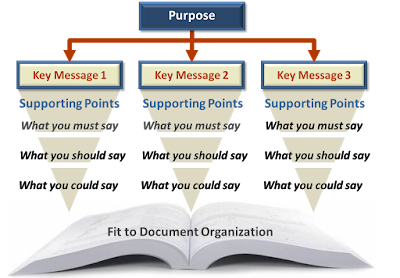
Fit your content outline to the document structure.
To this point you've based your outline on importance rather than the
flow of the document. Now you need to translate it into whatever
document structure is necessary. This can be difficult, but without the
planning steps above you'd be much more likely to omit or obscure your
key messages. Beware of slavish devotion to a traditional document
outline. You may determine that a reorganization is appropriate to
feature your most important content. For example, I favor putting
conclusions and recommendations—your most important information—at the
front of a report rather than the traditional position in the back.
Now you can start writing.
Having built a detailed content outline and fitted it to your document
structure, the writing comes much easier—and the result will be much
better. By the way, this process is even more powerful for team writing
assignments. Rather than the usual divide-and-conquer approach, get your
team together to work through the above planning process. The
collective brainstorming is much more likely to lead to a document that
will get the results you want.
 Many (if not most) technical professionals are ineffective writers. That fact is widely acknowledged. The question is does anyone really care? I don't see A/E firms investing much in helping their staff become more proficient writers.
Perhaps they haven't considered the costs of poor writing: Lost proposals, weak marketing, unapproved solutions, project mistakes, client claims, interoffice conflict, lost productivity—to name a few. I have seen all of these over the years as a result of poorly written proposals, reports, contracts, policies, correspondence, emails, or procedures.
On the flip side, strong writing can yield substantial business benefits. I'm hardly a distinguished writer, but I've compiled a 75% proposal win rate over the last 20 years, producing more than $300 million in fees. I helped my previous employer generate millions of dollars in new business that started with prospective clients contacting us because of something we'd written. I wrote letters to regulatory agencies making the case for regulatory exceptions that allowed innovative solutions saving our clients over $18 million.
The business case for strong writing is too compelling to be ignored, although it commonly is in our profession. But you don't have to settle for the status quo. By applying a few principles of what I call Power Writing, you and your colleagues can get the results you've been missing out on. What is Power Writing? It's writing that delivers the desired result. To accomplish that, you need to attend to three basic principles:
Many (if not most) technical professionals are ineffective writers. That fact is widely acknowledged. The question is does anyone really care? I don't see A/E firms investing much in helping their staff become more proficient writers.
Perhaps they haven't considered the costs of poor writing: Lost proposals, weak marketing, unapproved solutions, project mistakes, client claims, interoffice conflict, lost productivity—to name a few. I have seen all of these over the years as a result of poorly written proposals, reports, contracts, policies, correspondence, emails, or procedures.
On the flip side, strong writing can yield substantial business benefits. I'm hardly a distinguished writer, but I've compiled a 75% proposal win rate over the last 20 years, producing more than $300 million in fees. I helped my previous employer generate millions of dollars in new business that started with prospective clients contacting us because of something we'd written. I wrote letters to regulatory agencies making the case for regulatory exceptions that allowed innovative solutions saving our clients over $18 million.
The business case for strong writing is too compelling to be ignored, although it commonly is in our profession. But you don't have to settle for the status quo. By applying a few principles of what I call Power Writing, you and your colleagues can get the results you've been missing out on. What is Power Writing? It's writing that delivers the desired result. To accomplish that, you need to attend to three basic principles:
1. Purpose Driven: Define the Desired Result. As Yogi Berra famously quipped, "If you don't know where you're going, you'll end up somewhere else." Technical professionals often jump right into writing without much planning, or a clear understanding of what it is they're trying to accomplish. Everything you write has a purpose, but the chances are you don't really think about it. You just start writing because you have something to say. Yet simply communicating your message often falls short of getting the result you want.
Power Writing demands a plan, what it is you want to achieve and how that will be facilitated through your writing. At the most basic level, you are typically seeking to do one of three things—inform, instruct, or influence. Each of these broad objectives calls for a different approach to writing. When you're not clear on your purpose, you're more likely to write a proposal that reads like a technical report. Or a report that has no clear objective. Or a work process description that seems to ignore the needs of the people following it.
Once you have your purpose identified, the next step is to determine your Key Messages. These are the 3-5 things that you absolutely must communicate effectively to achieve your purpose. For each Key Message, you then want to define the supporting points that are needed to clarify and validate your point. This process results in a detailed content outline that will guide your writing.
2. Reader Focused: Facilitate Message Reception. Achieving your purpose is ultimately dependent upon your readers. It takes two to have successful communication. I liken it to a forward pass in football. The quarterback must deliver the ball on target, but the receiver has to catch it. If you're like most, your focus as a writer is on making the pass. But you need to give equal attention to making sure it is received.
A good example of this is email. If you send an email to a client or colleague, you may feel you did your job. But if the recipient doesn't read it or misunderstands it, don't you share some responsibility for that outcome? Power Writing isn't just sending out the equivalent of perfect spirals, but delivering it in a way that makes it more catchable.
That happens in several ways. Foremost, you need to try to see the issue from your readers' perspective. Then they'll be more interested in what you have to say. A common disconnect in our industry is approaching a project from a purely technical perspective when the client is more concerned with the business or stakeholder implications. You won't likely accomplish your purpose in writing unless it aligns in some way with what your readers want or value.
Reader-focused writing also means making it user friendly. One of the best ways to do this is to convey your message as efficiently as possible. Did you know it takes the average adult about one hour to read 35 pages of text? You should write with the expectation that it won't be read word for word (yes, even your emails). Make your main points skimmable. Make effective use of graphics. Use words everyone understands. Write in a conversational tone that easily connects.
3. Engages the Heart: Move Your Readers to Act. Of course, not everything you write is intended to spur your readers to action. But the most important writing you do is when you want to influence a particular response. It's unfortunate, then, that technical professionals struggle so much with persuasive writing. A big part of the problem is that they have been taught to write in a manner that is fundamentally nonpersuasive.
Technical writing is by nature intellectual, objective, impersonal, and features-laden. This style of writing—which pervades our profession—avoids personal language, keeps opinions to ourselves, provides more detail than the audience needs, and buries the main selling points in information overload. It may suffice when writing a study report, technical paper, or O&M manual. But it is entirely the wrong approach when you want to persuade clients, regulators, the public, or employees.
To move your readers to act, you need to engage the heart. That's because persuasion is driven by emotion and supported by logic—not the other way around. It is the human spirit that influences and inspires, and there is precious little of it evident in most of the writing we see in our industry. If you want to be more persuasive, let me suggest you start by dispatching the "technicalese" in favor of acknowledging in your writing the humanity in both you and your audience.
I think the power of writing has been grossly undervalued in the A/E industry. So I want to devote the next few posts to explaining in more detail how to become a Power Writer.
 My 17-year-old daughter has decided to become an engineer, but she had no idea which engineering discipline to choose. Since I have connections in the profession, I began setting up appointments for her to meet with different kinds of engineers to see which discipline appealed to her most.
We started with the two that I'm most familiar with—civil and environmental. These engineers did a great job selling their specialty, but none really connected with my daughter. Then one of my clients arranged for her to tour the mechanical engineering department at Virginia Tech. The light came on. She came back with an unexpected amount of enthusiasm (after all, like many engineers, she had been mainly drawn to the profession because she was good at math).
What was it that caught her attention? Well, the robotics laboratory was fascinating, of course. But the attraction went deeper. When she visited the previous engineering offices, they inevitably pulled out plan sets to show her their work. They designed things that others built. In the mechanical engineering lab, students designed, built, tested, and refined their work products. It was much more hands-on.
Now I'm not going to suggest that one field of engineering is better than another. That is a personal preference, and all engineering disciplines do valuable work. But I'm convinced there is added benefit in being closely connected with the desired end result. Ultimately, that's what engineers are hired to deliver. Does that mean that engineers must build what they design in order to be more valuable? No, but I do think many engineers could take a more active role in envisioning and shaping the final outcome.
I have several engineer friends who work in manufacturing. In talking to them about their work, the customer is typically a prominent part of the conversation. This is particularly true among those who make products for other businesses. They have a keen understanding of how their products help their customers succeed.
Among the engineers I work with in the AEC industry, not so much. Many of them seem disconnected from the ultimate project outcomes. Why is the client doing this? What is the business result that is needed? When I pose these questions, I'm often disappointed how little many engineers in our business understand the answers.
This problem isn't limited to the engineers, by the way. Architects can also be prone to overlooking the client's desired end results. A common client complaint is that many architects seem to favor form over function, emphasizing aesthetic design values over practical priorities (such as staying within the client's budget!). One of my favorite architects once told me that his first responsibility was to create spaces that maximize functionality. Aesthetics take precedent, he said, only when the client has designated that as a critical function of the building.
So how can we do a better job connecting our work with the outcomes that ultimately drive our projects? If you follow this blog, you no doubt recognize that I've touched on this general theme before. I keep revisiting it because I keep seeing evidence that it is needed. So here are a few recommendations on how to make your work more results oriented:
Uncover the strategic drivers behind your projects. A/E projects typically help clients achieve strategic business or mission goals. Do you know what those are? Can you describe specifically how your design or solution will enable the client to fulfill those goals?
Don't overlook the human dimension of your solutions. People are always the primary benefactors of your projects. Yet many technical professionals tend to be more focused on the technical aspects of the work than how people are affected. When working on a technical problem, be sure to consider the human consequences. Your solution should explicitly address both the problem and how it impacts people.
Learn to describe your work in terms of its ultimate outcomes. I often point to our project descriptions as evidence that improvement is needed in this area. What do they describe? Typically the tasks performed. Sometimes the technical problem. Rarely do I read, in specific terms, of how the project helped the client be successful. The same is often true in our conversations with existing or prospective clients.
Promote greater cross-disciplinary collaboration. One of the most common project delivery problems I encounter is inadequate coordination between disciplines. This is a primary cause of design-related construction claims. But true collaboration across disciplines goes deeper than merely avoiding mistakes. It leverages the different perspectives and strengths of each discipline to deliver a more encompassing, higher value solution—one that looks beyond the details of project execution to achieving the project's ultimate goals.
Follow the project all the way through. Sometimes A/E firms are contracted through construction and even start-up. That enables you to have a more direct role in ensuring the project's ultimate success. But what if the contract ends with the completed design? I urge that you keep in contact with the client, offering advice and answering questions, helping the finished project achieve its stated goals. It's not all that uncommon that design-related problems occur during construction or operation that the design firm is not made aware of. It's best to monitor project progress to the end to be in a position to help and perhaps learn from your mistakes.
The most valuable thing we do in our industry is not engineering and architecture, but helping clients realize their dreams and ambitions. We solve problems that hamper their business performance and create facilities that enable their success. When we get closer to the desired end results, the perceived value of our work increases. Agree or disagree? Do you have other suggestions for how our profession can be more directly involved in delivering business results?
My 17-year-old daughter has decided to become an engineer, but she had no idea which engineering discipline to choose. Since I have connections in the profession, I began setting up appointments for her to meet with different kinds of engineers to see which discipline appealed to her most.
We started with the two that I'm most familiar with—civil and environmental. These engineers did a great job selling their specialty, but none really connected with my daughter. Then one of my clients arranged for her to tour the mechanical engineering department at Virginia Tech. The light came on. She came back with an unexpected amount of enthusiasm (after all, like many engineers, she had been mainly drawn to the profession because she was good at math).
What was it that caught her attention? Well, the robotics laboratory was fascinating, of course. But the attraction went deeper. When she visited the previous engineering offices, they inevitably pulled out plan sets to show her their work. They designed things that others built. In the mechanical engineering lab, students designed, built, tested, and refined their work products. It was much more hands-on.
Now I'm not going to suggest that one field of engineering is better than another. That is a personal preference, and all engineering disciplines do valuable work. But I'm convinced there is added benefit in being closely connected with the desired end result. Ultimately, that's what engineers are hired to deliver. Does that mean that engineers must build what they design in order to be more valuable? No, but I do think many engineers could take a more active role in envisioning and shaping the final outcome.
I have several engineer friends who work in manufacturing. In talking to them about their work, the customer is typically a prominent part of the conversation. This is particularly true among those who make products for other businesses. They have a keen understanding of how their products help their customers succeed.
Among the engineers I work with in the AEC industry, not so much. Many of them seem disconnected from the ultimate project outcomes. Why is the client doing this? What is the business result that is needed? When I pose these questions, I'm often disappointed how little many engineers in our business understand the answers.
This problem isn't limited to the engineers, by the way. Architects can also be prone to overlooking the client's desired end results. A common client complaint is that many architects seem to favor form over function, emphasizing aesthetic design values over practical priorities (such as staying within the client's budget!). One of my favorite architects once told me that his first responsibility was to create spaces that maximize functionality. Aesthetics take precedent, he said, only when the client has designated that as a critical function of the building.
So how can we do a better job connecting our work with the outcomes that ultimately drive our projects? If you follow this blog, you no doubt recognize that I've touched on this general theme before. I keep revisiting it because I keep seeing evidence that it is needed. So here are a few recommendations on how to make your work more results oriented:
Uncover the strategic drivers behind your projects. A/E projects typically help clients achieve strategic business or mission goals. Do you know what those are? Can you describe specifically how your design or solution will enable the client to fulfill those goals?
Don't overlook the human dimension of your solutions. People are always the primary benefactors of your projects. Yet many technical professionals tend to be more focused on the technical aspects of the work than how people are affected. When working on a technical problem, be sure to consider the human consequences. Your solution should explicitly address both the problem and how it impacts people.
Learn to describe your work in terms of its ultimate outcomes. I often point to our project descriptions as evidence that improvement is needed in this area. What do they describe? Typically the tasks performed. Sometimes the technical problem. Rarely do I read, in specific terms, of how the project helped the client be successful. The same is often true in our conversations with existing or prospective clients.
Promote greater cross-disciplinary collaboration. One of the most common project delivery problems I encounter is inadequate coordination between disciplines. This is a primary cause of design-related construction claims. But true collaboration across disciplines goes deeper than merely avoiding mistakes. It leverages the different perspectives and strengths of each discipline to deliver a more encompassing, higher value solution—one that looks beyond the details of project execution to achieving the project's ultimate goals.
Follow the project all the way through. Sometimes A/E firms are contracted through construction and even start-up. That enables you to have a more direct role in ensuring the project's ultimate success. But what if the contract ends with the completed design? I urge that you keep in contact with the client, offering advice and answering questions, helping the finished project achieve its stated goals. It's not all that uncommon that design-related problems occur during construction or operation that the design firm is not made aware of. It's best to monitor project progress to the end to be in a position to help and perhaps learn from your mistakes.
The most valuable thing we do in our industry is not engineering and architecture, but helping clients realize their dreams and ambitions. We solve problems that hamper their business performance and create facilities that enable their success. When we get closer to the desired end results, the perceived value of our work increases. Agree or disagree? Do you have other suggestions for how our profession can be more directly involved in delivering business results?
 Want to get something done in the A/E business?
Manage it like a project. That's my standard advice when confronted with
almost any kind of corporate initiative. Need more sales? Make it a
project. Need to increase profitability? Make it a project. Need to
improve client service? Same answer. Projects are what we do best, so
the more we can fit other corporate activities into a similar framework,
the better.
In my last post, I mentioned a study by Accenture
of companies that are among the leaders in providing the "branded
experience" to their customers. The study found that these companies
share two key traits: (1) they have a deliberate process for delivering a
consistently great customer experience and (2) they regularly solicit
customer feedback to determine how they're doing and what they can do
better. The vast majority of A/E firms do neither.
So
in this post, let me focus on the first strategy—managing the service
delivery process. When it comes to providing great client service, the
vast majority of firms simply rely on their good people doing the right
thing for the client. There's no planning, little process, few
standards, no metrics. We would never entrust our technical work
products to such an unstructured approach. Why? Because the results
would be wildly inconsistent.
And
that's what most firms get with their service delivery. Some
individuals have strong client skills and consistently delight their
clients. Others fail to provide clients the personal attention and
responsiveness they expect, focusing instead on the technical aspects of
the work. The only way to provide consistently good service is to
manage it. Like a project.
Granted,
not all aspects of client service are manageable. You have to have
decent interpersonal skills and a genuine concern for the client (no
process can overcome the lack of these!). But we can still plan, design,
implement, and measure important dimensions of the client experience,
just like the technical components of our projects:
Want to get something done in the A/E business?
Manage it like a project. That's my standard advice when confronted with
almost any kind of corporate initiative. Need more sales? Make it a
project. Need to increase profitability? Make it a project. Need to
improve client service? Same answer. Projects are what we do best, so
the more we can fit other corporate activities into a similar framework,
the better.
In my last post, I mentioned a study by Accenture
of companies that are among the leaders in providing the "branded
experience" to their customers. The study found that these companies
share two key traits: (1) they have a deliberate process for delivering a
consistently great customer experience and (2) they regularly solicit
customer feedback to determine how they're doing and what they can do
better. The vast majority of A/E firms do neither.
So
in this post, let me focus on the first strategy—managing the service
delivery process. When it comes to providing great client service, the
vast majority of firms simply rely on their good people doing the right
thing for the client. There's no planning, little process, few
standards, no metrics. We would never entrust our technical work
products to such an unstructured approach. Why? Because the results
would be wildly inconsistent.
And
that's what most firms get with their service delivery. Some
individuals have strong client skills and consistently delight their
clients. Others fail to provide clients the personal attention and
responsiveness they expect, focusing instead on the technical aspects of
the work. The only way to provide consistently good service is to
manage it. Like a project.
Granted,
not all aspects of client service are manageable. You have to have
decent interpersonal skills and a genuine concern for the client (no
process can overcome the lack of these!). But we can still plan, design,
implement, and measure important dimensions of the client experience,
just like the technical components of our projects:
- Plan. The starting point is to uncover
what the client expects in terms of the working relationship. Such
expectations are rarely explicit in the contract or scope of work, yet
they strongly influence the client's experience.
- Design. Understanding the client's expectations, you then determine what actions are needed to meet or exceed them.
- Implement. Knowing is one thing, doing is
another. Most firms need healthy doses of support and encouragement to
raise service levels. Support can involve training, resources, and
holding people accountable.
- Measure. The most important measurement is
getting periodic feedback from clients. The basic questions: How are we
doing? What can we do better?
Let's break that process out in some more
detail. Below is a basic service delivery process that I've used with
many clients. Not every client is receptive (nor deserving) of such a
structured approach, but for those who are (usually your best clients),
this can be a definitive competitive advantage.
1. Benchmark Expectations
Uncovering
your client's hidden expectations is the foundation of managing the
service delivery process. Service benchmarking involves meeting with the
client at the outset of the project to establish mutual expectations
for the working relationship. The discussion should address issues such
as communication, decisions and client involvement, information and
data, deliverable standards, invoicing and payment, management of
changes, and performance feedback. You might find the Client Service Planner useful for this purpose.
2. Identify Gaps
The
focus of this process is meeting the unique expectations of your
client. So having completed the benchmarking step, the next activity is
to identify where what the client wants varies significantly from what
you normally do. This assessment should take into account both the
standard practices of the firm and the respective project manager or office.
3. Create Service Deliverables
The
next step is to create "service deliverables" to close the gaps
identified. This means treating the delivery of service like the
delivery of any other work product, as mentioned above. Producing
service deliverables involves defining a discrete set of tasks that can
be assigned, scheduled, budgeted, tracked, and closed like any other
project task. This moves service delivery from the realm of the ethereal
to the realm of the manageable. Some additional guidelines:
- Give special attention to those requiring
significant resources or coordination. Focus on those involving multiple
responsible persons or significant costs, or those with potential to
impact the project schedule.
- Alert the client of the costs of special deliverables.
Don't automatically acquiesce to every request the client may make if
there are substantial costs or difficulties associated with satisfying
the request. Explain the added costs (in terms of budget, time, etc.)
and let the client decide if he or she is willing to assume them. Look
for other satisfactory alternatives where appropriate.
- Don't commit to what you cannot deliver. While
this seems obvious, there are many PMs, who in their zeal to please the
client, make promises that they are unlikely able to keep. The old adage
"under-promise and over-deliver" is still good advice.
4. Prepare a Service Plan
The client service plan provides direction for the project team on how service deliverables
will be handled in the context of the project. Preparing such a plan
recognizes that client service involves time and resources like other
project tasks, and should be managed accordingly. This plan is typically
brief and is integrated into the overall project management plan (in most cases, the completed Client Service Planner will suffice).
Since the quality of service deliverables
is much more subjective than technical work products, it's especially
important to secure the client's endorsement of the client service plan.
Confirm that the planned service deliverables
fully meet the client's expectations. Delivering great service is
largely dependent on the client doing his or her part in making the
relationship work. The plan provides a blueprint for key aspects of that
relationship, and involves both parties meeting the obligations
established in it.
5. Implement the Service Plan
The preceding
steps of the service delivery process alone will set your firm apart
from all but a few. But these activities ultimately accomplish nothing
if there is inadequate follow-through. Your commitment to the branded
experience obviously must extend beyond the planning stages to the point of
delivery. This involves not just implementing the service plan, but
being responsive to the client's evolving needs and expectations through
the course of the project.
The over-arching goal: Make every client encounter (every touchpoint) a positive experience.
6. Solicit Client Feedback
Getting
regular feedback from your clients is critical to ensuring that you are
meeting expectations. Two primary means are recommended: (1) ongoing
dialogue with the client and (2) periodic formal survey. I outlined a general approach to this in a previous post.
By
the way, service sells. Not unsubstantiated claims that "we listen" or
"we give personal attention." But if you describe the above process in a
sales call, proposal, or shortlist presentation, you will immediately
set your firm apart.
I've
seen it be a major factor in winning large contracts. One such client, a
major airline, responded in the interview: "Why is no one else talking
about this? The reason we're replacing five of our six current
consultants is we're not happy with their service. Yet you are the only ones to tell us how
you will serve us better."
Finally, let me close by summarizing the three basic advantages of a service delivery process:
- Managing service delivery like other project tasks puts it more in the realm of the familiar
- It enables you to provide a more consistent level of service across the organization
- It converts client service into a more tangible (you can draw it) value proposition
Could this be your best unexploited opportunity to differentiate your firm? Test drive it with a few of your clients and see for yourself.
 At the core of your firm's brand is what the client experiences working with your firm. So how much time and money do you spend on enhancing the quality of the client experiences you deliver? If you're like the overwhelming majority of A/E firms, it pales in comparison to the investment made in your technical capabilities. So here's a golden opportunity to differentiate your firm: Deliver what is known as the branded experience.
What is the branded experience? The most helpful definition I've found comes from the Forum Corporation. They describe the branded experience as one characterized by four basic qualities: (1) it's consistent, (2) it's intentional, (3) it's differentiated, and (4) it's valued. Notice that the first two characteristics are dependent on the service provider; the second two are discerned by the customer. The branded experience involves a sort of informal partnership between the two parties.
Accenture conducted a study to determine what separates the companies that deliver the branded experience from the rest. The study found that the best companies did two important things:
At the core of your firm's brand is what the client experiences working with your firm. So how much time and money do you spend on enhancing the quality of the client experiences you deliver? If you're like the overwhelming majority of A/E firms, it pales in comparison to the investment made in your technical capabilities. So here's a golden opportunity to differentiate your firm: Deliver what is known as the branded experience.
What is the branded experience? The most helpful definition I've found comes from the Forum Corporation. They describe the branded experience as one characterized by four basic qualities: (1) it's consistent, (2) it's intentional, (3) it's differentiated, and (4) it's valued. Notice that the first two characteristics are dependent on the service provider; the second two are discerned by the customer. The branded experience involves a sort of informal partnership between the two parties.
Accenture conducted a study to determine what separates the companies that deliver the branded experience from the rest. The study found that the best companies did two important things:
- They had a formal process for consistently delivering the branded experience
- They rigorously solicited customer feedback to determine what customers want
Notice the alignment between Accenture's and Forum's research? Companies that have a delivery process are intentional and able to provide consistent customer experiences. Those that regularly solicit feedback can determine what customers think is different and what they value.
So how are we doing in our industry? Over the years, I've polled hundreds of firms on this topic at events where I've spoken. I've yet to find a firm that has a true client experience delivery process (other than firms I've worked with). I'm sure there are a few out there, but they are rare. Only about one in four firms I've polled have a formal process for client feedback. The company behind the Client Feedback Tool claims that only 5% of A/E firms collect client feedback regularly.
In my research of differentiation strategies for professional service firms, delivering the branded client experience is at or near the top of the list. This reflects a general trend in business, popularized by the book The Experience Economy. The most distinctive and successful brands across multiple industries generally provide great customer experiences. There's certainly evidence within our own industry that clients place a higher value on the experience that we have typically acknowledged.
So how is your firm doing in delivering the branded experience? The graphic below, adopted from the Forum Corporation, is a handy way to assess where you stand in the service-level progression leading to the branded experience:
Random experience. At this level, the customer experience is neither consistent or intentional. It varies from one time to another depending on which individual service provider you work with, which office or department, or what service or product you received. In other words, it's like working with many A/E firms. One project manager is very attentive, the next seemingly indifferent. One office provides great quality work products, another not so good.
Predictable experience. At this level, the experience is pretty consistent because the provider has taken steps to make it so. But it is either not significantly different from what you could get elsewhere or the difference isn't that valued by most customers, or both. I call this the Golden Arches Experience. The one thing McDonald's has going for it is that the food, service, and atmosphere are pretty consistent whichever of their 14,350 restaurants in the U.S. you visit. But that's also what's working against them!
Branded experience. When you reach this level, you're consistently delivering an experience that customers value. You don't get here simply because you've got good people working for you. It requires intentional effort. It requires a reliable experience delivery process. And it requires regularly asking clients what they really want, and how you can do better. There are many good A/E firms out there, and clients are generally satisfied. But the opportunity remains for your firm to distinguish itself because it commits to the high standard of the branded experience.
Can you really package the delivery of professional services into some kind of consistent process? That's the question I plan to answer in my next post.
 What's necessary to build
sustainable business success? Lasting client relationships. Imagine if
you never had any repeat business. Could you survive? Highly unlikely.
So keeping existing clients deserves every bit the focus that finding new ones does.
It's
interesting, then, that most firms pay substantially more attention to
winning new clients than taking care of their current ones. If you doubt that conclusion, consider these questions:
How much of your strategic plan is devoted to improving business
development compared to improving client care? Do you have a sales
process, but not a relationship building process? Which receives more of
your training budget? Or more discussion in staff meetings?
Obviously, there's
nothing wrong with giving emphasis to business development. In fact,
most firms could stand to give it more. But let's not overlook the fact
that the best way to grow your business is usually through existing
client relationships. Are you taking steps to make those relationships
stronger? Here are five suggestions to do just that:
1. Create a client relationship building process.
You probably have a few individuals in your firm who are skilled at
nurturing strong client relationships. And some who aren't. Therein lies
the problem—a crucial function that's left to individual competency and
initiative. You don't manage projects that way; there are standard
procedures to ensure some measure of consistency. In fact there are many
less critical activities in your firm that have been defined as a
repeatable process.
So
why not an approach for building client relationships? Of course, there
are interpersonal dynamics in relationships that are not easily
programed. But if marriages can be strengthened by applying generic tips
from a book or conference, such improvements can certainly be realized
with clients. The key is to define certain elements of relationship
building that lend themselves to being replicated across the
organization. Here's how to get started:
What's necessary to build
sustainable business success? Lasting client relationships. Imagine if
you never had any repeat business. Could you survive? Highly unlikely.
So keeping existing clients deserves every bit the focus that finding new ones does.
It's
interesting, then, that most firms pay substantially more attention to
winning new clients than taking care of their current ones. If you doubt that conclusion, consider these questions:
How much of your strategic plan is devoted to improving business
development compared to improving client care? Do you have a sales
process, but not a relationship building process? Which receives more of
your training budget? Or more discussion in staff meetings?
Obviously, there's
nothing wrong with giving emphasis to business development. In fact,
most firms could stand to give it more. But let's not overlook the fact
that the best way to grow your business is usually through existing
client relationships. Are you taking steps to make those relationships
stronger? Here are five suggestions to do just that:
1. Create a client relationship building process.
You probably have a few individuals in your firm who are skilled at
nurturing strong client relationships. And some who aren't. Therein lies
the problem—a crucial function that's left to individual competency and
initiative. You don't manage projects that way; there are standard
procedures to ensure some measure of consistency. In fact there are many
less critical activities in your firm that have been defined as a
repeatable process.
So
why not an approach for building client relationships? Of course, there
are interpersonal dynamics in relationships that are not easily
programed. But if marriages can be strengthened by applying generic tips
from a book or conference, such improvements can certainly be realized
with clients. The key is to define certain elements of relationship
building that lend themselves to being replicated across the
organization. Here's how to get started:
- Identify common traits among your best client relationships
- Determine the steps that were taken to build those relationships
- Develop a relationship building process based on your assessment
- Pilot this process with a few clients with growth potential
2. Clarify mutual expectations.
For every project, you develop a scope of work, schedule, and budget
that the client reviews and approves. But many aspects of the working
relationship—such as communication, decision making, client involvement,
managing changes, and monitoring satisfaction—are not discussed and
explicitly agreed upon with the client. In my experience, most service breakdowns are
caused by unknown or misunderstood expectations.
To
delight clients and win their loyalty, you need to know how they like
to be served. Over time this becomes clearer, but you may not make it
that far. How much better to simply ask what the client's expectations
are up front, as well as to share what you'd like from the client in return to make the relationship stronger? This is a practice I call "service benchmarking," and you may find my Client Service Planner helpful in this regard.
3. Increase client touches.
These are simply the direct and indirect interactions you have with
clients. Too often these touches are limited to times of necessity. This
is the project manager who only calls when there's a problem. Or the
principal who is out of sight until the next RFP approaches. Clients
notice. Perhaps the biggest complaint I've heard in the many client
interviews I've conducted is the failure of A/E firms to communicate proactively.
What are some ways to increase client touches? Consider the following:
- Invite the client to your project kickoff meeting
- Send monthly project status reports
- Share internal project meeting minutes and action items
- Call to discuss issues before they become problems
- Send articles, papers, reports,and tools of interest to the client
4. Periodically seek performance feedback. Having clarified expectations in advance, it's important to check in on occasion
to ask how well you're doing. The frequency and timing of these
discussions is hopefully one of the expectations you established during
the benchmarking step. This is another valuable way to increase client
touches.
About 1 in 4 firms in this business formally solicit client feedback, and reportedly only about 5
percent do it regularly. So there's a tremendous opportunity for you to
distinguish your firm with your clients. Here are some tips for getting
effective feedback:
- Have someone not directly involved in the project do this
- Mix both discussions and a standard questionnaire
- Talk to multiple parties in the client organization if possible
- Be sure to follow up promptly to any concerns identified
5. Don't disappear between projects.
This relates back to my advice about client touches; don't limit them
only to when it's in your self interest. Keep in touch with the client
after the project is completed—for the client's sake. For one thing, the
real value of your work isn't realized until the facility you designed
is put into operation or the recommendations in your report are acted
upon. You want to be talking with the client when these moments of
truth happen, whether it's part of your contract or not.
Offer
whatever support you can to further ensure the project's success. But
you also want to demonstrate your interest in the client's success
outside the project. Provide helpful information and advice, in person,
over the phone, and digitally (as part of your content marketing effort).
The time between projects (assuming you've won the client's trust to do
another project together) can be a productive relationship building
time, because it's often unexpected. Having met the client's
expectations during the project, this is another chance to exceed them.

 No doubt you're aware that it's easier and more cost-effective to
sell to existing clients than to new ones. That's reflected in the fact
that 70% of architectural and engineering firms' work comes from repeat
clients. So naturally most firms make it a priority to sell additional
services—what's called cross selling—to existing clients.
No doubt you're aware that it's easier and more cost-effective to
sell to existing clients than to new ones. That's reflected in the fact
that 70% of architectural and engineering firms' work comes from repeat
clients. So naturally most firms make it a priority to sell additional
services—what's called cross selling—to existing clients.


 Posts
Posts

