Tuesday, October 28, 2008

Getting Feedback From Clients

The branded experience is consistent and intentional. This requires standards, process, and managed effort. I outlined one proven approach in my last post. The branded experience is also viewed as distinct and valued by the client. The only way to know what the client is thinking is to ask.

That's simple, but often ignored, advice. Most A/E firms don't regularly solicit feedback from their clients. I presume they believe they either (1) don't need to or (2) don't care to know. Of course, no one would ever admit to not caring what the client thinks. Yet surveys indicate that clients often feel like their A/E providers don't really care. In fact, PSMJ reports that two-thirds of clients who defect do so because of perceived indifference.

Client surveys also debunk the notion that we can safely assume we understand what our clients want without specifically asking. In conducting such surveys myself, as well as facilitating several "partnering" sessions, I can testify that there are commonly problems about which the A/E firm is unaware. In my mind, no firm will succeed in providing consistently great service (experiences) without a regular program of seeking client feedback.

A critical first step in understanding client expectations comes at project outset, in a process I call "service benchmarking." This involves asking the client specific questions about how you can optimize the working relationship and deliver a great experience. From this information, you define what actions are needed to meet client expectations. Then you need to periodically ask, "How are we doing? What can we do better?"

There are two primary means of collecting feedback from your clients that I suggest:

Ongoing dialogue with the client. This should be your primary method for getting feedback. It involves regular conversations with the client at intervals mutually determined during the benchmarking step, plus a final debriefing at the end of the project or major project phase. This activity is best handled by someone other than the project manager, typically the principal in charge or other senior manager. This person assumes the role of Client Advocate (see below).

Formal client survey. A standardized questionnaire is used primarily for tracking service performance trends across the company. While this is highly recommended, you should not use the formal survey as the primary means of gathering client-specific feedback. It's too impersonal for that purpose (although the Client Advocate can personally administer the survey, which makes it more personal and responsive).

The Client Advocate's Role

Many firms assume that their PMs can adequately monitor client satisfaction. But even the most diligent PMs can be sorely mistaken about their client's perception of their performance. Clients are often reluctant to voice their unhappiness to the PM, especially if the PM is perceived to be part of the problem.

That's why I advocate assigning every key client relationship a Client Advocate. Preferably this is someone who is not directly involved in the project work (except potentially in an advisory or oversight role). Otherwise they lose some of the objectivity and independence needed to function effectively as Client Advocate. This person's responsibilities include:
  • Monitors client satisfaction. Keeps in touch with the client from time to time (as mutually agreed upon), checking to see that the client remains fully satisfied with the firm's performance.

  • Ensures responsiveness. Acts as an in-house advocate for the client, seeing that the firm is fully responsive to client needs and expectations.

  • Acts as third-party liaison. Serves as the point of contact when the client has a problem or concern that he or she prefers not to discuss with the PM.

  • Conducts the periodic formal survey. Administers the formal survey and follows up to see that the firm responds to client concerns or suggestions that are uncovered in the survey.
The Formal Survey

Following are some suggestions for maximizing the success of the formal survey as part of your process for gathering client feedback:
  • Define appropriate interval. Either annually or biannually is recommended. The proper frequency will be guided in part by the nature of both the project and your relationship with the client.

  • Solicit the client's involvement in advance. Explain the purpose of the survey, its value to both parties, and the minimal time involved on the client's part. For long-term clients, request their ongoing participation.

  • Distribute the questionnaire electronically. Doing the survey in person or over the phone obviously has advantages. But I'm assuming your Client Advocate has already been talking to the client. The formal survey serves a different purpose and is more easily distributed by email--either as an attachment or with a link to a secure web site (Zoomerang.com is an excellent resource). Filling out the survey should be hassle free, requiring no more than about 10 minutes of the client's time.

  • Contact non-responders. Request responses within a week, then have the Client Advocate call or email to ask if the client received the survey (a not-so-subtle but friendly reminder). This will significantly improve your response rate. Remember, you've already had the client agree to participate.

  • Address problems promptly. When client concerns or complaints are uncovered (and undoubtedly this will happen from time to time), you need to respond promptly and appropriately. In fact, you should define the process for addressing client concerns before sending out the survey.

  • Share the results with your clients. A great way to demonstrate your commitment to great client service is to send a summary of the survey results to those clients who participated. Include in that summary the actions your firm plans to take to improve service.
For a questionnaire to use for this purpose, check out this one on my website. I developed it jointly with PSMJ and have used it with good results for several years.

How to Get Started

This best feedback will come from clients who are: (1) convinced that your firm is indeed committed to client service improvement and (2) are willing to actively help your firm improve. These are clients who recognize the value of a strong working relationship and are willing to invest a little of their time in making it happen. Don't expect all your clients to participate. But take steps to engage those who will.
  • Start with your best clients. The best way to generate momentum for this process is to start with those clients who have a mutual interest in strengthening the working relationship. Pick an easily manageable number of clients to start, where you're confident you can be fully responsive to whatever feedback you receive. Then expand to other clients when you're ready.

  • Build accountability into the process. Make sure your Client Advocates are fulfilling their roles, keeping in touch with the client, promptly responding to any client concerns, and seeing that the project team is meeting expectations. Anything less and the process will quickly lose credibility with both your clients and your employees.

  • Communicate client feedback to the staff. Everyone in your firm should be engaged in continually improving service and striving to deliver the branded experience. Feedback from clients is the fuel that keeps the fires of continuous improvement burning. Give all employees a stake in helping your firm become a service leader. Share feedback, lessons learned, and success stories.

Friday, October 24, 2008

The Branded Experience Delivery Process

Want to get something done in the A/E business? Manage it like a project. That's my standard advice when confronted with almost any kind of corporate initiative. Need more sales? Make it a project. Need to increase profitability? Make it a project. Need to improve client service? Same answer. Projects are what we do best, so the more we can fit other corporate activities into a similar framework the better.

In my last post, I mentioned a study by Accenture of companies that are among the leaders in providing the "branded experience" to their customers. The study found that these companies share two key traits: (1) they have a deliberate process for delivering a consistently great customer experience and (2) they regularly solicit customer feedback to determine how they're doing and what they can do better. The vast majority of A/E firms do neither.

So in this post, let me focus on the first strategy--managing the service delivery process. When it comes to providing great client service, the vast majority of firms simply rely on their good people doing the right thing for the client. There's no planning, little process, few standards, no metrics. We would never entrust our technical work products to such an unstructured approach. Why? Because the results would be wildly inconsistent.

And that's what most firms get with their service delivery. Some individuals have strong client skills and consistently delight their clients. Others fail to provide clients the personal attention and responsiveness they expect, focusing instead on the technical aspects of the work. The only way to provide consistently good service is to manage it. Like a project.

Granted, not all aspects of client service are manageable. You have to have decent interpersonal skills and a genuine concern for the client (no process can overcome the lack of these!). But we can still plan, design, implement, and measure important dimensions of the client experience, just like the technical components of our projects.

  • Plan. The starting point is to uncover what the client expects in terms of the working relationship. Such expectations are rarely explicit in the contract or scope of work, yet they strongly influence the client's experience.
  • Design. Understanding the client's expectations, you then determine what actions are needed to meet or exceed them.
  • Implement. Knowing is one thing, doing is another. Most firms need healthy doses of support and encouragement to raise service levels. Support can involve training, resources, and holding accountable.

  • Measure. The most important measurement is getting periodic feedback from clients. The basic questions: How are we doing? What can we do better?

Let's break that process out in some more detail. Below is a basic service delivery process that I've used with many clients. Not every client is receptive (nor deserving) of such a structured approach, but for those who are (usually your best clients), this can be a definitive competitive advantage.


1. Benchmark Expectations

Uncovering your client's hidden expectations is the foundation of managing the service delivery process. Service benchmarking involves meeting with the client at the outset of the project to establish mutual expectations for the working relationship. The discussion should address issues such as communication, decisions and client involvement, information and data, deliverable standards, invoicing and payment, management of changes, and performance feedback. You might find the Client Service Planner useful for this purpose.

2. Identify Gaps

The focus of this process is meeting the unique expectations of your client. So having completed the benchmarking step, the next activity is to identify where what the client wants varies significantly from what you normally do. This assessment should take into account both the standard practices of the firm and the respective project manager.

3. Create Service Deliverables

The next step is to create "service deliverables" to close the gaps identified. This means treating the delivery of service like the delivery of any other work product, as mentioned above. Producing service deliverables involves defining a discrete set of tasks that can be assigned, scheduled, budgeted, tracked, and closed like any other project task. This moves service delivery from the realm of the ethereal to the realm of the manageable. Some additional guidelines:

  • Give special attention to those requiring significant resources or coordination. Focus on those involving multiple responsible persons or significant costs, or those with potential to impact the project schedule.
  • Alert the client of the costs of special deliverables. Don't automatically acquiesce to every request the client may make if there are substantial costs or difficulties associated with satisfying the request. Explain the added costs (in terms of budget, time, etc.) and let the client decide if he or she is willing to assume them. Look for other satisfactory alternatives where appropriate.

  • Don't commit to what you cannot deliver. While this seems obvious, there are many PMs who in their zeal to please the client, make promises that they are unlikely able to keep. The old adage "under-promise and over-deliver" is still good advice.

4. Prepare a Service Plan

The client service plan provides direction for the project team on how service deliverables will be handled in the context of the project. Preparing such a plan recognizes that client service involves time and resources like other project tasks, and should be managed accordingly. This plan is typically brief and is integrated into the overall project management plan (in many cases, the completed Client Service Planner will suffice).

Since the quality of service deliverables is much more subjective than technical work products, it's especially important to secure the client's endorsement of the client service plan. Confirm that the planned service deliverables fully meet the client's expectations. Delivering great service is largely dependent on the client doing his or her part in making the relationship work. The plan provides a blueprint for key aspects of that relationship, and involves both parties meeting the obligations established in it.

5. Implement the Service Plan

The preceding steps of the service delivery process alone will set your firm apart from all but a few. But these activities ultimately accomplish nothing if there is inadequate follow-through. Your commitment to the branded experience must extend beyond the planning stages to the point of delivery. This involves not just implementing the service plan, but being responsive to the client's evolving needs and expectations through the course of the project.

The over-arching goal: Make every client encounter (every touchpoint) a positive experience.

6. Solicit Client Feedback

Getting regular feedback from your clients is critical to ensuring that you are meeting expectations. Two primary means are recommended: (1) ongoing dialogue with the client and (2) periodic formal survey. I'm going to explore this topic in more detail in a subsequent post.

By the way, service sells. Not unsubstantiated claims that "we listen" or "we give personal attention." But if you described the above process in a sales call, proposal, or shortlist presentation, you would immediately set your firm apart. I've seen it be a major factor in winning large contracts. One such client, a major airline, responded in the interview: "Why is no one else talking about this? The reason we're getting rid of five or our six current consultants is poor service. Yet you are the only ones to tell us how you will serve us better." Something to keep in mind in these tough economic times.

Finally, let me close by summarizing the three basic advantages of a service delivery process:

  • Managing service delivery like other project tasks puts it more in the realm of the familiar

  • It enables you to provide a more consistent level of service across the organization

  • It converts client service into a more tangible (you can draw it) value proposition

Monday, October 20, 2008

Delivering the Branded Experience

At the core of your firm's brand is what the client experiences working with your firm. So how much time and money do you spend on enhancing the quality of the client experiences you deliver? If you're like the overwhelming majority of firms in this business, it pales in comparison to the investment made in your technical capabilities. So here's a golden opportunity to differentiate your firm: Deliver what is known as the "branded experience."

What is the branded experience? The most helpful definition I've found comes from the Forum Corporation. They describe the branded experience as one characterized by four basic qualities: (1) consistent, (2) intentional, (3) differentiated, and (4) valued. Notice that the first two characteristics are dependent on the provider; the second two are discerned by the customer. The branded experience involves a partnership of a sort between the two parties.

Accenture conducted a study to determine what separates the companies that deliver the branded experience from the rest. The study found that the best companies consistently did two important things:
  • They had a deliberate process for consistently delivering the branded experience.
  • They rigorously solicited customer feedback to determine what customers want.

The aforementioned partnership is evident in these results. The customer provides feedback about what he or she really wants. The provider takes the necessary steps to ensure that it is delivered to the customer. Pretty simple, but pretty rare--especially in our profession.

Over the years, I've polled hundreds of firms at events where I've spoken, asking how many formally solicit performance feedback from their clients. Only about 25% respond afirmatively. Despite the common claim, "We provide great client service," most firms don't ask for verification of that claim. They assume they know without asking.

But when I've conducted client surveys for A/E firms, it's not uncommon to be surprised by clients' dissatisfaction. BTI Consulting has found that despite repeat business rates of 80% among professional service firms, less than 25% of their clients would recommend them. And RainToday.com found that 88% of A/E firm clients were open to changing providers. Apparently our clients aren't as happy as we have been prone to think.

I've also asked how many firms have a formal service (i.e., client experience) delivery process. I've yet to have anyone raise their hand, although I have read of a handful of firms that have done something similar. If consistency and intentionality are key to offering the branded experience, is not some kind of formal process necessary? That's what the Accenture study found. But in our industry, we rely predominantly on "good people doing the right thing for the client." Unfortunately, most firms don't have enough of those "good people" to do the "right thing" consistently.

So how is your firm doing in delivering the branded experience? The graphic below, adopted from The Forum Corporation, is a handy way to assess where you stand in the service-level progression leading to the branded experience:

Random experience. At this level, the customer experience is neither consistent or intentional. It varies from one time to another depending on which individual service provider you work with, which office, or what service or product you received. In other words, it's like working with most A/E firms. One project manager is very attentive, the next indifferent. One office provides great quality work products, another not so good.

Predictable experience. At this level, the experience is pretty consistent because the provider has taken steps to make it so. But it is either not significantly different from what you could get from another provider or the difference isn't that important to the customer, or both. I call this the Golden Arches Experience. The one thing MacDonalds has going for it is that the food, service, and atmosphere is pretty consistent whichever restaurant you visit. But that's also what's working against them!

Branded experience. When you reach this level, you're consistently delivering an experience that customers value. You don't get here simply because you've got good people working for you. It requires intentional effort. It requires a reliable experience delivery process. And it requires regularly asking clients what they really want.

Can you really package the delivery of professional services into some kind of consistent process? That's the question I hope to answer in my next post.

Wednesday, October 15, 2008

The Experience Trumps Expertise

If Starbucks can transform a commodity like coffee into a high-end product, can we not do the same with our services? Does the Experience Economy apply to the A/E business? Let's consider the evidence.

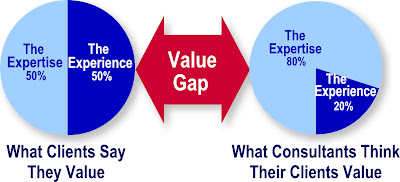
As reported in their book Clientship, authors Kennedy and Greenberg asked over 500 clients this question: "If you consider that we provide you value in two ways and that together they equal 100%, how would you divide up the value between our technical skills (what we do) and our client-service skills (how we do it)?" The prevailing response was 50/50. Another way to put it is that the experience is every bit as valuable to the client as the expertise. Research within our industry by BTI Consulting and Roger Pickar came to similar conclusions.

Could these data be understating the value of the experience? I think so. Consider when your firm has lost clients. Was it because of technical shortcomings or inadequate service? When I've asked that question of principals and managers in our business, they overwhelmingly agree that it's service-related problems (70 to 90% of the time). So we get it. Right?

Not so fast, my friend. BTI asked firms to identify their primary competitive advantage. Eighty percent said it was their technical capability. Only 20% said it was their client service. We clearly place more emphasis on technical excellence than on service excellence (i.e., the client experience). That bias is evident in our business development strategies, our proposals, and our marketing materials. It's evident in the disproportionate amount of time and money we invest in technical improvement versus service improvement.

Our priorities are out of step with those of our clients. There is a substantial gap between what our clients value and what we think they value. And that gap represents an exciting opportunity to distinguish our firms. Indeed, I believe that closing that gap is the best differentiation strategy available to most A/E firms.


So where do you begin? That's the subject of upcoming posts. Next up: The prized product of the Experience Economy is what is commonly referred to as the branded experience. What is it and how do you create it? Stay tuned.

Tuesday, October 7, 2008

Three Value-Adding Strategies

Value drives business success. The most successful companies are those that provide distinctive value. And the more value delivered to the customer, the more value is typically returned to the provider in the form of revenues, profits, loyalty, etc. The management mandate seems clear: Find ways to create more customer value than your competition.

Yet value creation as a strategic objective is rarely mentioned in the A/E industry. We prefer concepts like quality, expertise, and experience. Unfortunately, these assets typically don't differentiate us; rather they are expected. Added value, by contrast, differentiates. Could our lack of attention to value creation be a root cause of our inability to measure up to other professions? (See these earlier posts: "What's Wrong With This Picture?" and "Diagnosing the Gap")

So what do we mean by value? A good working definition is: Value is the perceived benefit received minus the associated cost. Added value, then, is when one receives more benefit for the cost than was expected.

There are a couple of important points to take from these definitions:
  • Value is a personal and subjective concept that exists in the customer's mind (if you need proof, consider the crazy things that sell for a premium on Ebay!). Value cannot be accurately quantified monetarily (although purchase price is one measure). Nor can we presume what our client values; we must uncover it.

  • Since value exists in the mind, it is delivered in both tangible and intangible forms. But ultimately it is always experienced in the mind. This is a hard concept for many technical professionals to grasp. We often consider technical excellence our most valuable "product." Yet just as excellent food in a restaurant with poor service equals low value, so it is with a solid project delivered with seeming indifference by the A/E provider.

With these concepts in mind, let's consider what my research suggests are the three most common value-adding strategies. These are not specific to our industry, but they are certainly all relevant to us.

Satisfy unmet or emerging needs. This is the classic sweet spot in the product/service life cycle. When you are among few firms that can meet a client's need, the solution you deliver is of high value. Yet supply and demand are only part of the value equation. One study of professional firms found that the less the client understands the problem, the more valuable the solution. Getting involved early in helping clients solve emerging, unfamiliar problems is a clear opportunity to provide higher value (hence reap higher profits and greater loyalty).

Among the three value-adding strategies, this is easily the one most commonly pursued by A/E firms. No doubt your firm has periodically added new services to address emerging markets less populated by your competitors. Unfortunately, this strategy is typically short-lived. As the need becomes better known, more firms move to meet it. With more choices of providers, the perceived value (and profit) declines. A/E firms are also routinely slow to respond to emerging opportunities. By the time most invest in new services, their competitors usually already know about it and are doing the same.

Meet clients' strategic needs. Strategic needs are those that affect the overall success of the client's organization. They commonly relate to financial, competitive, political, or operational factors. Given the critical nature of strategic needs, clients are usually willing to pay a premium for good solutions. That's one reason, I'm convinced, why other professional firms demand higher multipliers than we do--they meet strategic needs.

A/E firms once played a much larger role in this arena, but we have forfeited many of the high value, strategic services to other professionals like management consulting and accounting firms (even banks in some cases!). The role of "trusted advisor" is at the heart of meeting strategic needs. Many A/E firms find themselves merely filling orders for design services rather than helping clients define their needs and choose the optimum course of action. We are often focused to a fault on doing what we do best, unable to connect our work to the strategic needs that drive our projects

Provide distinct, valued customer experiences. This is the fundamental asset at the core of what is commonly called the Experience Economy. Businesses that command the highest profits these days usually have tapped into the Experience Economy. Consider the entertainment industry (including spectator sports), theme parks, adventure travel. Consider how the "Starbucks Experience" multiplied the value of a commodity like coffee. A five-star restaurant, as I mentioned earlier, is defined as much by its ambiance and service as by its food.

Among the three value-adding strategies, in my opinion, this one holds the greatest promise for our industry. While A/E firms routinely claim to provide "great service" (i.e., a great client experience), rare is the firm that has embraced this strategy as a management priority. In subsequent posts, I will outline why there is so much potential for adding value through superior service and what is required to ascend to the ranks of the truly differentiated.

Thursday, October 2, 2008

Responding to the Financial Crisis

The languishing economy took a frightening turn last week with the implosion of the financial markets. As Congress scrambles to pass a rescue bill, many economists are predicting that the worst is yet to come. For most of us, this is the greatest economic uncertainty we have faced in our lifetimes.

The A/E industry has been faring reasonably well up to this point. In fact, some sectors of our industry are still quite strong. What impact will recent events have on our business? No one knows. But we can expect the reverberations of the current crisis to spread.

The biggest concern is the availability of credit. Even if government intervention frees up some capital, fears will persist, bringing increased caution on the part of lenders. How deep or how long this problem will be is a matter of speculation even among the experts.

So what can A/E firm principals and managers do in the face of such uncertainty. Here are a few suggestions:

  • Stay close to your clients. Keep informed about how the crisis is affecting them. Look for opportunities to help, even if it involves meeting needs outside your normal scope of services. Subcontract additional expertise if you need it, or make referrals. The point is to make yourself as indispensable as possible. Become the trusted advisor. And, of course, make sure you keep service levels high.

  • Reactivate your network. Relationships are critical in uncertain times. If you're like most who have neglected their network, this is a good time to renew your commitment to keeping in touch. Make serving others the primary objective in reconnecting. Offer information, advice, referrals--simple encouragement may suffice! Networking has always been a key growth strategy. Now it may serve as your safety net.

  • Keep communication flowing with employees. Undoubtedly recent events have increased anxiety in your organization, especially if your business isn't doing particularly well. It's important to keep employees informed, or better still, engage them in helping address the emerging challenges. Organize brainstorming sessions to come up with ideas to increase service, improve efficiency, explore new opportunities. Transparency is always recommended, but don't overwhelm with bad news. Spend more time talking about the positive changes the company is undertaking.

  • Step up business development efforts. If you're cutting costs, don't start here, as many firms are prone to do. Most companies have much room for improvement in how they develop new business. The current economic climate can provide the needed incentive to finally make some real headway. This is a good time to better organize your sales effort. For advice on how to do this, check out this previous post.

  • Be diligent in managing cash flow. Poor collections have been a persistent problem in our industry, with receivables averaging over 70 days. Add to that the failure to get invoices out in a timely fashion. Consequently, many firms are forced to borrow to make payroll at times. Such loans may become more difficult to obtain. So now is the time to improve your firm's cash flow management. Obviously, many clients are also facing financial challenges, so collections will be more problematic for some. That's all the more reason to get serious about it.

None of these suggestions are novel. You've heard them before. The point is that uncertain times call for getting back to those things you can count on. Has your firm been neglecting any of the above? This would be a good time build on the good business practice foundations that will help your firm weather the storm that appears to be brewing on the horizon (or may have already arrived for your business).